Working outdoors means sun exposure is part of the job. While a tan might seem harmless, long-term exposure to ultraviolet (UV) radiation is a serious occupational hazard that can cause skin cancer, eye damage, premature aging of the skin, and heat-related illness. UV protection is just as critical as hard hats, safety boots, and high-visibility clothing for outdoor workers.
Understanding UV Radiation and Workplace Risk
UV radiation from the sun is strongest between 10:00 a.m. and 4:00 p.m., in summer months, at higher altitudes, and on or near reflective surfaces like concrete, sand, water, and metal. UV can penetrate clouds, so overcast conditions do not remove the risk.
Outdoor workers in construction, roadwork, agriculture, landscaping, utilities, roofing, waste management, maritime, and mining can receive up to 10 times more UV exposure than indoor workers over a lifetime, significantly increasing their risk for skin cancer and eye damage.
Why UV Protection is an Occupational Safety Issue
Skin cancer is one of the most common cancers globally, and occupational sun exposure is a major driver. In the United States, the American Cancer Society estimates that more than 5 million cases of skin cancer are diagnosed each year, many of which are linked to UV radiation from the sun or tanning devices. Regular, unprotected sun exposure during working hours is a controllable risk factor.
Employers have a duty to identify and control foreseeable workplace hazards. UV rays are an environmental hazard that can be managed with an effective sun safety program, just like noise, chemicals, or moving equipment. Integrating UV protection into your safety toolbox talks helps reinforce that sun safety is mandatory, not optional.
Recognizing the Health Effects of UV Exposure
Outdoor workers should be trained to recognize both short-term and long-term effects of UV exposure:
Short-term effects:
- Sunburn: Red, painful skin that may blister and peel.
- Photokeratitis: Also called “snow blindness” or “welder’s flash,” causing painful, gritty sensation in the eyes, tearing, and light sensitivity.
- Heat stress: UV exposure often coincides with high temperatures, increasing risk of heat exhaustion and heat stroke.
Long-term effects:
- Skin cancer: Including basal cell carcinoma, squamous cell carcinoma, and melanoma. These can be disfiguring or fatal if not detected early.
- Premature aging: Wrinkles, leathery skin, and dark spots.
- Eye damage: Cataracts and other eye diseases can be linked to cumulative UV exposure.
- Immune suppression: Excessive UV radiation can weaken the immune system over time.
Key UV Protection Controls for Outdoor Worksites
The most effective UV protection strategy applies a hierarchy of controls: elimination or substitution is not usually possible for sun exposure, so focus on engineering and administrative controls, along with personal protective equipment (PPE).
1. Engineering controls: Use shade and barriers
- Provide shade structures: Use tents, canopies, awnings, or vehicle-based shade where practical, especially at break areas and workstations where workers are stationary.
- Use temporary shelters: For work like flagging or equipment monitoring, place portable shelters when feasible to reduce direct sun exposure.
- Adjust equipment placement: Position workstations, tool cribs, and material laydown areas to minimize time in direct sun.
2. Administrative controls: Plan work to reduce UV exposure
- Schedule high-UV tasks earlier or later: Plan the most sun-exposed work for early morning or late afternoon when UV levels are lower.
- Rotate workers: Rotate tasks so one person is not continuously in full sun throughout the shift.
- Plan shaded breaks: Require regular breaks in shaded or indoor areas with cool water available.
- Monitor the UV index: Include UV index checks in daily pre-start meetings, and increase controls when the index is high.
- Implement a written sun safety policy: Make UV protection a formal part of your health and safety program, including training, PPE requirements, and incident reporting.
3. Personal protective equipment: Wear the right sun-safe gear
- Clothing:
- Long-sleeved shirts and long pants: Choose lightweight, breathable, tightly woven fabrics. Where possible, select clothing with a high Ultraviolet Protection Factor (UPF).
- High-visibility and UV-protective garments: Some high-vis workwear is also rated for UV protection; check labels and purchase accordingly.
- Wide-brimmed hats: Use hats with at least a 7.5 cm (3 inch) brim all around to protect the ears, face, and neck. For hard hats, use brim attachments or neck flaps.
- Neck and ear protection: Use neck shades or flaps that attach to hard hats or helmets in high-UV environments.
- Eye protection:
- Safety glasses or goggles with UV protection: Select lenses that block 99–100% of UVA and UVB rays, and ensure they meet impact standards appropriate for the job.
- Wraparound styles: Use frames that fit closely to the face and sides to reduce UV entering around the lenses.
- Sunscreen:
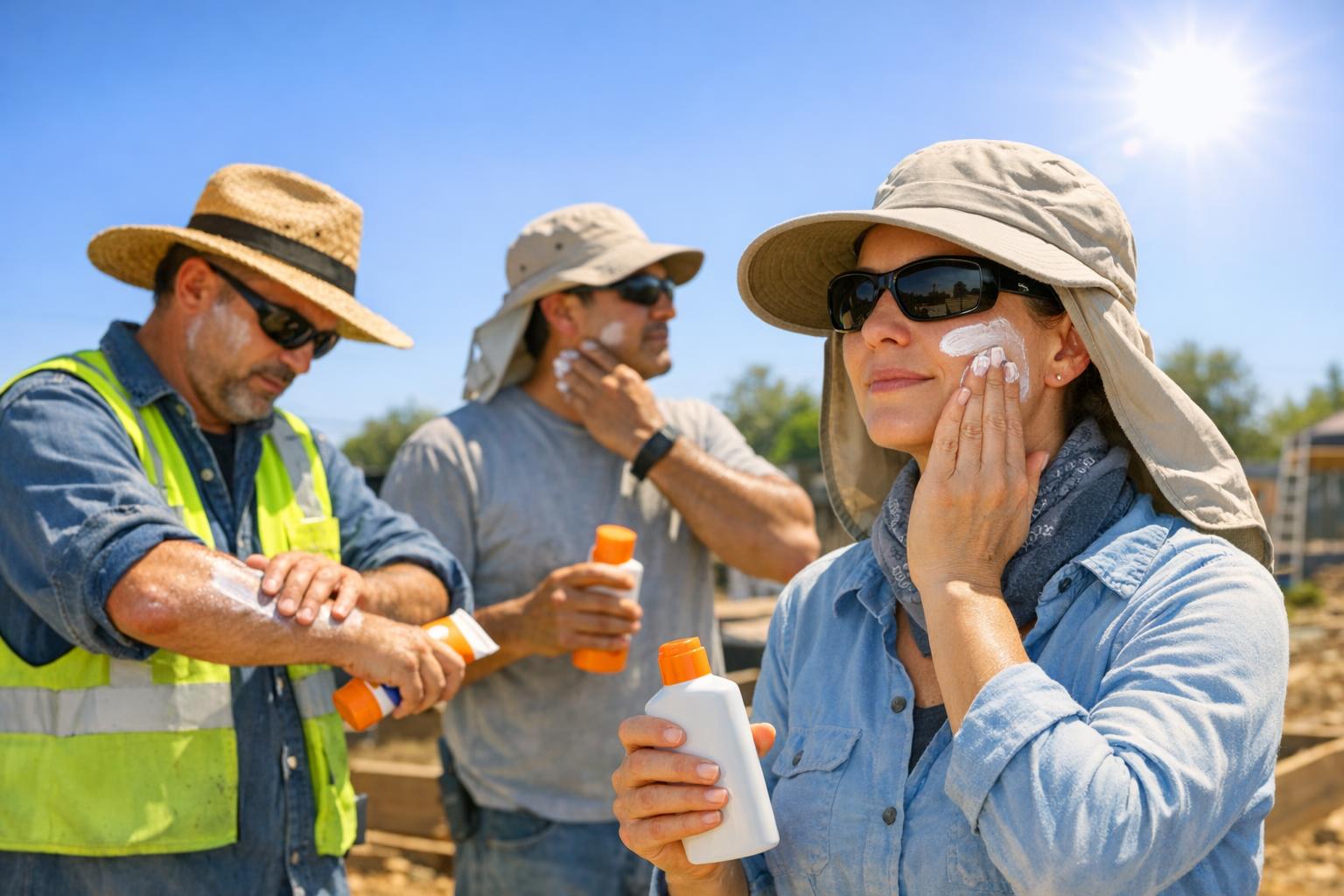
- Broad-spectrum sunscreen: Use SPF 30 or higher broad-spectrum sunscreen that protects against both UVA and UVB.
- Apply correctly: Apply generously 15–30 minutes before going outdoors, covering all exposed skin including ears, nose, lips, neck, and backs of hands.
- Reapply regularly: Reapply at least every two hours, and more often if sweating heavily or after wiping skin with towels or clothing.
- Provide access at work: Employers should provide sunscreen at key locations and make application part of pre-start routines.
Safe Work Practices for UV Protection
- Use shade whenever possible: Move tasks into shade when it does not compromise safety or productivity.
- Avoid intentional tanning: Tanning is skin damage. Workers should not view a tan as a sign of health or toughness.
- Hydrate regularly: Dehydration increases heat stress risk when working in the sun. Provide cool drinking water and encourage frequent small sips.
- Check skin regularly: Encourage workers to look for new or changing moles, spots that bleed or do not heal, or rough, scaly patches. Early detection is critical.
- Protect all seasons: UV exposure can be high even on cool or cloudy days, and UV can reflect off snow, water, and concrete, so controls must be year-round.
Supervisor Responsibilities for UV Safety
- Model the behavior: Supervisors must wear hats, sunglasses, protective clothing, and sunscreen to set the standard.
- Enforce PPE use: Treat UV protection PPE like any other required safety equipment.
- Include UV in toolbox talks: Cover UV risks and controls regularly, especially at the start of summer or before high-UV tasks.
- Respond to health concerns: Encourage workers to report severe sunburn, eye issues, or heat-related symptoms immediately and support medical evaluation when needed.
- Review and improve: After hot or high-UV periods, review incidents or near misses and adjust your sun safety plan accordingly.
Worker Responsibilities for UV Protection
- Follow site rules on sun safety: Use all required PPE and participate in training.
- Prepare for the weather: Arrive with appropriate clothing and hats suitable for forecast conditions.
- Use provided sunscreen properly: Apply and reapply during the shift, especially on high-UV days.
- Speak up about unsafe conditions: Report missing shade, lack of water, or broken PPE to supervisors.
- Look out for each other: If a co-worker shows signs of severe sunburn, confusion, dizziness, or eye pain, stop work and get help.
Making UV Protection Part of Your Safety Culture
Treating UV radiation as an occupational hazard—rather than a personal lifestyle issue—helps protect workers’ long-term health and reduces preventable skin and eye damage. When sun safety is embedded into pre-start meetings, risk assessments, PPE requirements, and supervision, it becomes a normal, expected part of working outdoors. Blocking the rays is not only about comfort; it is a critical safety practice that keeps outdoor workers healthy on the job and for years to come.
Links Referenced
- American Cancer Society – Ultraviolet (UV) Radiation
- NIOSH – Sun Exposure
- CDC – Skin Cancer Basic Information