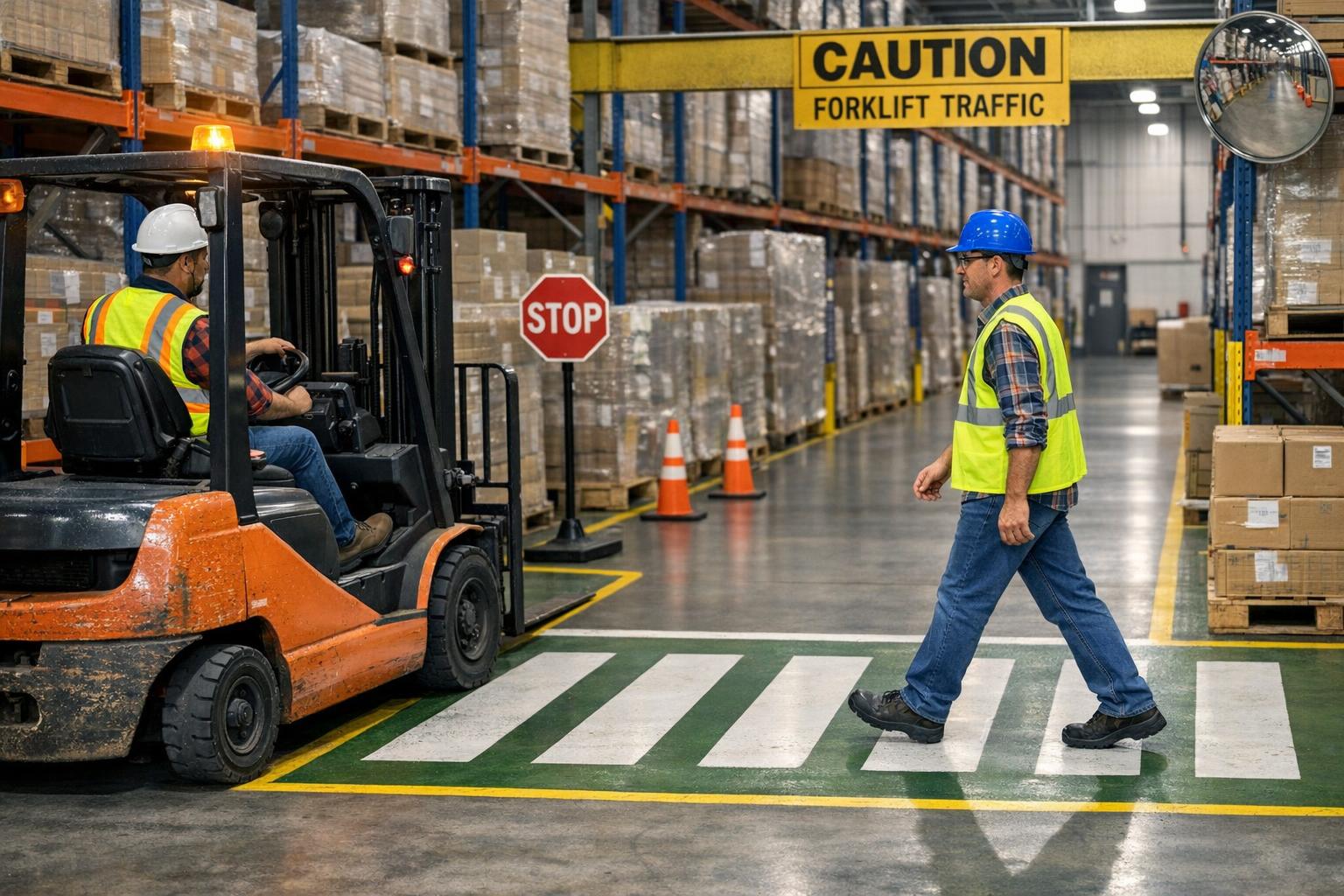
Forklifts and pedestrians can work safely together, but only when everyone understands the risks and follows clear rules. Every year, thousands of workers are injured in forklift incidents, and many of these injuries involve pedestrians who were struck, pinned, or crushed because someone took a shortcut or made an assumption. Strong forklift and pedestrian safety rules remove those shortcuts and assumptions before someone gets hurt.
According to the U.S. Occupational Safety and Health Administration (OSHA), there are an estimated 85 fatal forklift accidents each year in the U.S. and about 34,900 serious injuries, with forklift overturns and struck‑by incidents among the leading causes. The UK’s Health and Safety Executive (HSE) reports that being struck by a moving vehicle remains one of the main causes of workplace fatalities and major injuries, many involving lift trucks in warehouses and yards. These numbers reflect preventable events where better separation, visibility, and communication would have made the difference.
A forklift is a powerful piece of mobile plant, not just another tool. It can weigh several tonnes, carry heavy or unstable loads, and has large blind spots. It cannot stop or turn quickly, especially when loaded, and it is easy for pedestrians to underestimate its speed or assume the driver has seen them. A key principle of forklift and pedestrian safety is simple: people and powered industrial trucks should be separated wherever reasonably practicable.
Site Layout and Traffic Management for Forklift and Pedestrian Safety
Start with the layout of your workplace. A safe system of work is not just about driver skill; it depends on how traffic and people are routed and controlled.
- Provide clearly marked pedestrian walkways that are physically separated from forklift routes wherever possible using barriers, guardrails, bollards, or racking.
- Avoid shared access points where pedestrians and trucks compete for space, particularly at doorways, loading bays, and intersections.
- Use one‑way traffic systems for forklifts to reduce reversing and blind corners.
- Mark crossing points clearly with high‑visibility floor markings and signage, and restrict crossings to those designated areas.
- Keep forklift routes free of obstructions, leaks, and debris so operators can maintain proper control and visibility.
Good traffic management also includes speed control. Set and enforce safe speed limits for forklifts based on conditions, visibility, and congestion. Where possible, use engineered controls such as speed limiters or zoning technology to prevent unsafe speeds in pedestrian‑heavy areas.
Operator Responsibilities and Safe Driving Practices
Licensed and trained forklift operators are central to pedestrian safety. An operator must drive defensively, always assuming pedestrians may be distracted or unaware.
Key safe driving behaviours include:
- Conduct a pre‑start inspection before every shift: brakes, steering, horn, warning lights, reversing alarm, mast, forks, tyres, and seat belt. Take any unsafe truck out of service and report defects immediately.
- Wear the seat belt and required PPE. A restrained operator is better able to maintain control and avoid serious injury in an overturn.
- Travel at a walking pace where pedestrians are present and even slower at intersections, corners, and through doors.
- Never drive with an elevated load. Keep forks low to the ground with the mast tilted back to stabilise the load and maintain visibility.
- Drive in reverse if the load obstructs forward vision, but only if it is safe and the operator is competent to do so.
- Stop and sound the horn at blind corners, doorways, and intersections, and proceed only when the path is clearly visible and clear of people.
- Maintain a safe distance from pedestrians, other vehicles, and edges such as docks, mezzanines, and ramps.
- Never carry passengers on the truck unless it is designed for that purpose and has an approved seat.
Operators must also refuse unsafe requests, such as lifting a person on the forks, racing to finish tasks, or driving with an unstable or oversized load that compromises control and visibility.
Pedestrian Responsibilities and Safe Behaviour
Pedestrian safety around forklifts depends on predictable, disciplined behaviour. Every person on site should understand that the forklift has right of way on its designated routes, but the goal is to avoid any close interaction altogether.
Pedestrians should:
- Stay on designated walkways and use marked crossing points. Do not cut across forklift lanes or weave between trucks and loads.
- Make eye contact with the operator before crossing a forklift route or approaching a truck. Never assume the operator has seen you.
- Wait for the truck to stop and for a clear signal from the operator before walking in front of, behind, or near it.
- Keep a safe distance from operating forklifts and never walk or stand under raised forks, loads, or masts.
- Avoid distractions such as mobile phones, headphones, or conversations when walking through areas where forklifts operate.
- Do not attempt to steady a load, push on a pallet, or help guide a forklift by hand. Only trained operators should handle loads.
Visitors and contractors must be briefed on pedestrian routes, exclusion zones, and local rules upon arrival and should be escorted through higher‑risk areas.
Visibility and Warning Systems for Forklift and Pedestrian Safety
Many forklift‑pedestrian incidents occur because one party simply did not see the other. Improving visibility and communication is one of the most effective controls.
Consider the following measures:
- Ensure forklifts have functioning lights, horns, reversing alarms, and mirrors, and that operators use them appropriately.
- Install convex mirrors at blind intersections and doorways to give both drivers and pedestrians better sight lines.
- Use high‑visibility clothing for pedestrians and operators in shared areas so they stand out against backgrounds and racking.
- Keep lighting adequate and consistent across aisles, loading docks, and outdoor yards, reducing glare and deep shadows.
- Introduce visual and audible warning systems such as blue or red spotlights, floor‑projection warning lines, and proximity alert systems that warn both drivers and pedestrians when they are too close.
Verbal communication is equally important. Operators and pedestrians should use clear hand signals and voice when necessary, ensuring any agreement to proceed is understood by both parties.
Training, Supervision, and Continuous Improvement
Forklift and pedestrian safety is not a one‑off briefing; it requires ongoing training and active supervision. All forklift operators must receive formal training, practical evaluation, and periodic retraining. Pedestrians who work around forklifts should receive toolbox talks and refreshers that focus on situational awareness, routes, and rule changes.
Supervisors play a critical role by:
- Enforcing traffic and pedestrian rules consistently.
- Challenging unsafe shortcuts and behaviours immediately.
- Reviewing near‑misses and incident reports to identify trends and improvement opportunities.
- Involving workers in risk assessments and discussions about layout changes or new equipment.
Regular workplace inspections should specifically look at forklift‑pedestrian interactions. Check that walkways are respected and crossing points are used, that warning systems are working and effective, and that no new obstructions or blind spots have emerged. Adjust your controls when work patterns, staffing levels, or equipment change.
A Layered Approach to Forklift and Pedestrian Safety
The most effective strategy for forklift and pedestrian safety is layered. Relying solely on “be careful” or PPE is not enough. Combine:
- Elimination: Remove unnecessary forklift movements and pedestrian access where possible.
- Separation: Use design, barriers, and routing to keep people and trucks apart.
- Engineering controls: Lights, alarms, mirrors, speed limiters, proximity systems.
- Administrative controls: Procedures, training, supervision, and signage.
- Personal protective equipment: High‑vis clothing, safety footwear, and other site‑specific PPE.
When each layer is in place and actively managed, the chance of a forklift striking a pedestrian is significantly reduced. Everyone on site has a part to play in maintaining those layers, speaking up about hazards, and never accepting unsafe interaction between people and lift trucks as “part of the job.”
For more on powered industrial trucks, review our forklift safety rules and the key elements of effective forklift training programs. Three Sixty Safety also supports manufacturing and warehouse safety with audits and site inspections.