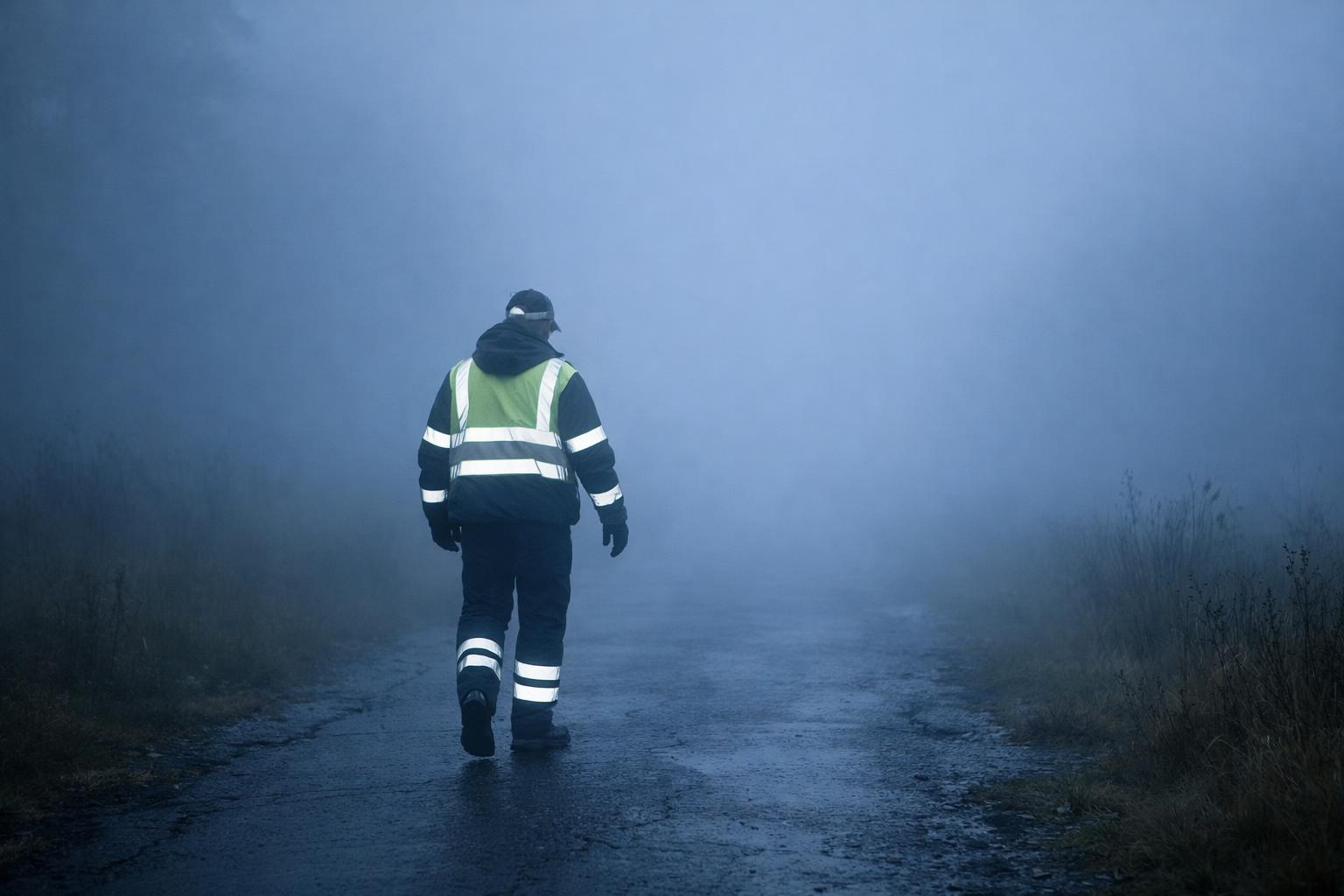
Fog reduces visibility but also changes how people judge speed and distance. Objects can appear farther away than they are, and reflective surfaces can create glare that hides hazards. Sound is also dampened, making it harder to hear approaching vehicles, plant, or spotters.
Key risk factors in dense fog include:
- Driving or operating plant at normal speeds with reduced sight distance
- Working near live traffic or mobile equipment without clear line of sight
- Poorly marked pedestrian routes and work zones
- Inadequate lighting, reflectivity, or high-visibility apparel
- Confusing or absent communication protocols between operators and spotters
Treat dense fog as a dynamic hazard. Conditions can change from clear to “zero visibility” in minutes, especially in low-lying areas, near water, or at elevation changes.
Fog-related crashes and near misses are often preventable when teams slow down, increase space, improve visibility, and tighten communication. The U.S. Federal Highway Administration notes that about 38,700 crashes, 600 fatalities, and 16,300 injuries occur every year in fog-related crashes in the U.S. alone. Those numbers highlight the importance of having clear procedures before a fog event, not during it. Federal Highway Administration – How Do Weather Events Impact Roads?
Pre-Work Planning for Fog Conditions
Planning is your first control. Before a shift, consider whether fog is likely and what work is planned.
Key planning actions:
- Review forecast and known fog “hot spots” on your site, route, or facility.
- Identify tasks that depend heavily on long sight distances (crane lifts, hauling, work near moving equipment).
- Establish clear triggers for delaying, rescheduling, or modifying work when visibility drops.
- Confirm communication methods (radios, hand signals, horns, backup alarms) and test them.
- Ensure adequate lighting, reflective signage, and barriers are available and in good condition.
Supervisors should communicate the fog plan at the pre-start meeting, including who has stop-work authority and how visibility will be assessed in the field.
Visibility Thresholds and Stop-Work Triggers
One of the most important controls is agreeing on when work stops or changes. Make it objective.
Examples of visibility triggers:
- If you cannot clearly see a fixed reference point at a set distance (e.g., 200–300 ft / 60–90 m) on driving routes, reduce speed and increase spacing.
- If you cannot see the next traffic cone, delineator, or flagger on a worksite, limit movements and consider stopping non-essential mobile plant.
- If operators cannot maintain direct visual contact with their spotter, stop the movement until visibility or communication is restored.
Establish a simple rule: if anyone on the crew believes visibility is too poor to work safely, they can call a pause without fear of reprisal.
Vehicle and Equipment Controls in Dense Fog
When fog is present and work must continue under a risk-assessed plan, tighten controls around any moving vehicle or mobile plant.
Key controls:
- Reduce speed significantly below posted or site limits. “Drive to conditions” means you can stop within the distance you can see.
- Increase following distance well beyond normal to allow extra reaction time.
- Use low-beam headlights; high beams reflect off fog and reduce visibility.
- Turn on hazard or strobe lights as required by company policy or regulation, especially on slow-moving or stopped vehicles.
- Keep windshields, mirrors, cameras, and lights clean and free from condensation.
- Avoid sudden braking or lane changes that others cannot anticipate or see.
- Where possible, restrict reversing and complex maneuvers in low visibility; redesign traffic flow to favor forward movement.
Operators should verbalize their movements on the radio before starting and again as they complete the maneuver, especially in congested areas.
Pedestrian and Ground Worker Safety
People on foot are at highest risk when visibility is reduced and vehicles are still moving.
Risk-reduction measures:
- Use designated, clearly marked pedestrian routes that are separated from vehicle paths wherever possible.
- Require Class 2 or Class 3 high-visibility garments (or your regional equivalent) with retroreflective striping. Replace faded or damaged vests.
- Provide additional lighting in walkways, access points, and around material laydown areas.
- Prohibit crossing active vehicle routes in dense fog unless traffic is stopped, controlled, or escorted.
- Use spotters or flaggers at blind intersections, gates, and high-traffic pinch points.
- Ensure workers remove hoodies, scarves, or PPE configurations that limit side vision or hearing when near moving equipment.
Workers should maintain “eye contact or no go” as a principle: if you cannot clearly see the operator and they cannot see you, stay clear of the line of fire.
Communication Protocols: Radios, Hand Signals, and Verification
Effective communication is your backup when visibility drops. When fog is present, assumptions and informal signals are not enough.
Core communication rules:
- Use two-way radios for critical movements such as entering haul roads, crossing traffic, moving large equipment, or traveling through blind spots.
- Standardize call signs for vehicles, work zones, and personnel so messages are clear and repeatable.
- Adopt a “three-step” communication loop for critical instructions: send, repeat back, confirm.
- Avoid radio chatter that is not work-related; keep channels clear for safety-critical information.
- When using hand signals, confirm that both operator and spotter are trained in the same standard signal set. Never improvise.
- Use one spotter per movement; multiple voices or conflicting signals create confusion.
If any instruction is unclear, stop and clarify before moving. Silence or guesswork in fog conditions is a direct hazard.
Site Controls, Signage, and Temporary Changes
In areas prone to fog, design the site or route to reduce visibility-related risk before an event occurs.
Examples of engineering and administrative controls:
- Install reflective markers, centerlines, edge lines, and signage that are visible in low light and fog.
- Use physical barriers (jersey barriers, guardrails, bollards) to separate pedestrians from vehicles where feasible.
- Identify and mark pull-out or safe-stop areas for vehicles caught in sudden fog.
- Develop and train an alternate traffic management plan for dense fog, including reduced speed zones, convoy procedures, or temporary closures.
- Coordinate with nearby facilities, traffic controllers, or dispatch centers so external traffic is aware of your fog procedures.
Regularly review incident data, near misses, and worker feedback to update these controls and improve layout or procedures over time.
Supervisor and Worker Responsibilities
Everyone on site plays a role in fog safety, but responsibilities differ.
Supervisors:
- Monitor weather forecasts and visibility throughout the shift.
- Enforce slow-downs, pauses, or shutdowns when visibility thresholds are exceeded.
- Ensure workers have functioning radios, lighting, and high-visibility apparel.
- Lead toolbox talks and refreshers when fog season starts or conditions are changing.
Workers:
- Report sudden changes in visibility immediately to supervisors or control rooms.
- Follow reduced speed limits and enhanced spacing without exception.
- Refuse unsafe movements when visibility or communication is inadequate.
- Watch out for new team members, visitors, or contractors who may not know site rules.
A shared mindset of “if we cannot see it, we will not move it” helps prevent rushed decisions in marginal conditions.
Toolbox Talk Discussion Prompts
Use the following prompts during your toolbox talk to engage the crew:
- Where on our site or route do we see the heaviest fog, and what can we change about how we work there?
- How will we decide, today, if visibility is too low to continue a task?
- What are our radio call signs and the exact phrasing we will use for critical moves?
- Are our spotters, drivers, and plant operators aligned on the same hand signals?
- What personal actions will each of us take when fog rolls in during this shift?
Document agreed actions and ensure they are communicated to all shifts, not just the team present at the talk.