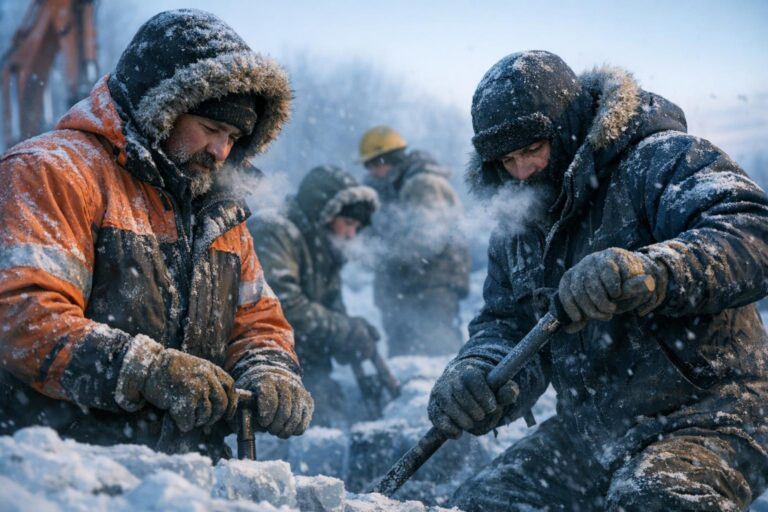
When temperatures drop, the risk of muscle strains, slips, trips and falls rises sharply on site. Cold weather tightens muscles, slows reaction time and can make even simple tasks more hazardous. A short, focused cold weather dynamic warm-up helps workers prepare their bodies for the demands of the job, reducing injuries and improving performance. Cold weather dynamic warm-ups take just 5 to 10 minutes at the start of a shift.
Dynamic warm-ups are especially important in construction, utilities, logistics, agriculture, mining and any work done outdoors or in unheated spaces. A dynamic warm-up uses controlled, active movements to increase blood flow, raise core temperature and gently move joints through their full range of motion. Unlike static stretching, it is designed to get workers moving, warm and ready to work safely in the cold.
Why Cold Weather Dynamic Warm-ups Matter
Cold environments affect muscles, tendons and joints. When workers start heavy tasks with “cold” muscles, they are more likely to suffer strains, sprains and other soft tissue injuries. Research indicates that warm muscles and connective tissues are more flexible and can better tolerate the loads and movements required for manual work.
Working in cold temperatures has also been linked with reduced dexterity and slower reaction times, factors that can contribute to incidents, especially where manual handling, power tools, ladders or mobile plant are involved. A cold weather dynamic warm-up helps counter these effects by increasing circulation and gently rehearsing the movements workers will perform on the job.
Dynamic Warm-ups vs. Static Stretching in Cold Weather
Many workers are familiar with static stretching, where a position is held for 15–30 seconds without movement. Static stretches can be useful after work or in a cool-down. Before heavy work in the cold, however, dynamic warm-ups are more effective because they:
- Increase heart rate and breathing in a controlled way
- Raise muscle temperature and improve elasticity
- Activate key muscle groups used in lifting, carrying and climbing
- Improve balance and coordination under realistic movement patterns
Dynamic movements are especially useful before tasks such as shovelling, repetitive lifting, overhead work, operating hand tools and climbing on scaffolds or equipment.
Core Elements of a Cold Weather Dynamic Warm-up
A practical cold weather dynamic warm-up for the job site should be:
- Short: 5–10 minutes
- Simple: easy to remember and lead without special equipment
- Task-specific: focused on the main body parts used in the day’s work
- Space-efficient: can be done in a laydown area, parking lot, yard or inside a shop
A typical cold weather dynamic warm-up includes:
- Light cardio to elevate heart rate
- Dynamic mobility for major joints (ankles, knees, hips, shoulders, spine)
- Activation exercises for key muscle groups (core, legs, upper back, shoulders)
- Gradual build to work-specific movements
Safety leaders should encourage foremen or supervisors to lead the warm-up as part of the daily toolbox talk before work begins, especially on cold mornings or when a cold front has just moved through.
Step-by-Step Cold Weather Dynamic Warm-up for the Job Site
The following sequence provides a structured, repeatable warm-up suitable for most outdoor crews. Workers should dress for the weather and maintain three points of contact or stable footing during all movements.
1. Light Whole-body Movement (2–3 minutes)
- Brisk walk on the spot or around the work area, pumping arms at a comfortable pace.
- Progress to gentle marching, lifting knees slightly higher while swinging arms.
2. Ankle and Lower Leg Mobility (1 minute)
- Ankle circles: standing and holding a stable support if needed, slowly circle one ankle 10 times in each direction, then switch legs.
- Heel-toe rocks: with feet hip-width apart, rock gently from heels to toes 10–15 times.
3. Dynamic Leg and Hip Warm-up (2–3 minutes)
- Leg swings front-to-back: hold a stable support; gently swing one leg forward and back in a controlled motion 10–15 times, then switch legs.
- Side leg swings: stand side-on to a guardrail or other support and swing leg across the body and out to the side 10–15 times each leg.
- Walking lunges: take a step forward, drop into a comfortable lunge without letting the back knee slam the ground, then step forward with the rear leg. Perform 8–10 lunges per leg, keeping the torso upright.
4. Upper Body and Shoulder Mobility (2 minutes)
- Arm circles: start with small circles and gradually increase to larger ones, 10 forward and 10 backward.
- Shoulder rolls: roll shoulders up, back and down 10 times, then reverse 10 times.
- Trunk rotations: stand with feet shoulder-width apart, arms crossed at chest height or hands on hips, and gently rotate the upper body side to side 10–15 times.
5. Core and Back Activation (2 minutes)
- Hip hinges: with feet shoulder-width apart, push hips back while maintaining a neutral spine and slight bend at the knees, then return to standing. Perform 10–15 repetitions to prepare for lifting tasks.
- Cat-camel standing version: with hands on thighs, gently arch and round the back through a comfortable range 10–12 times, keeping movements slow and controlled.
6. Work-specific Rehearsal (2–3 minutes)
Finish the cold weather dynamic warm-up with movements that mirror actual tasks:
- Simulated lifting: practice proper lifting technique with an empty or very light object, keeping loads close to the body and using the legs, not the back.
- Step-ups: if safe and appropriate, use a low, stable step to simulate climbing. Step up and down 10–12 times per leg while holding a handrail or stable support if available.
- Tool motion practice: without power or with an unloaded tool, rehearse safe body positions for shovelling, raking or using a manual tool, focusing on straight wrists, neutral spine and avoiding twisting.
Integrating Dynamic Warm-ups into Your Safety Program
For cold weather dynamic warm-ups to be effective, they must become part of the routine, not an occasional extra. Consider the following:
- Make dynamic warm-up a scheduled part of the pre-start or toolbox meeting on cold days.
- Assign a trained leader on each crew to run the warm-up consistently.
- Align the warm-up to common tasks: lifting, carrying, overhead work, ladder use or equipment access.
- Encourage workers to speak up if a particular movement causes pain and to modify the range to stay within a comfortable level.
Link the warm-up directly to your injury prevention goals. When workers understand that a 5–10 minute cold weather dynamic warm-up can reduce strains, sprains and lost-time incidents, they are more likely to participate actively and take it seriously.
Additional Cold Weather Safety Considerations
Dynamic warm-ups are one component of a broader cold weather safety strategy. Crews should also be reminded to:
- Wear layered clothing to trap warm air and allow adjustment as they heat up
- Protect extremities with insulated gloves, socks and head protection compatible with PPE
- Take scheduled warm-up breaks in heated shelters or vehicles when conditions are very cold
- Monitor themselves and co-workers for signs of cold stress, such as uncontrolled shivering, confusion or loss of coordination
Combining a consistent cold weather dynamic warm-up with proper clothing, work-rest cycles and safe work practices helps reduce musculoskeletal injuries while supporting productivity.
Pair your warm-up routine with our guides to preventing winter-related injuries and ergonomics and injury prevention, or contact Three Sixty Safety to build warm-ups into your site safety program.