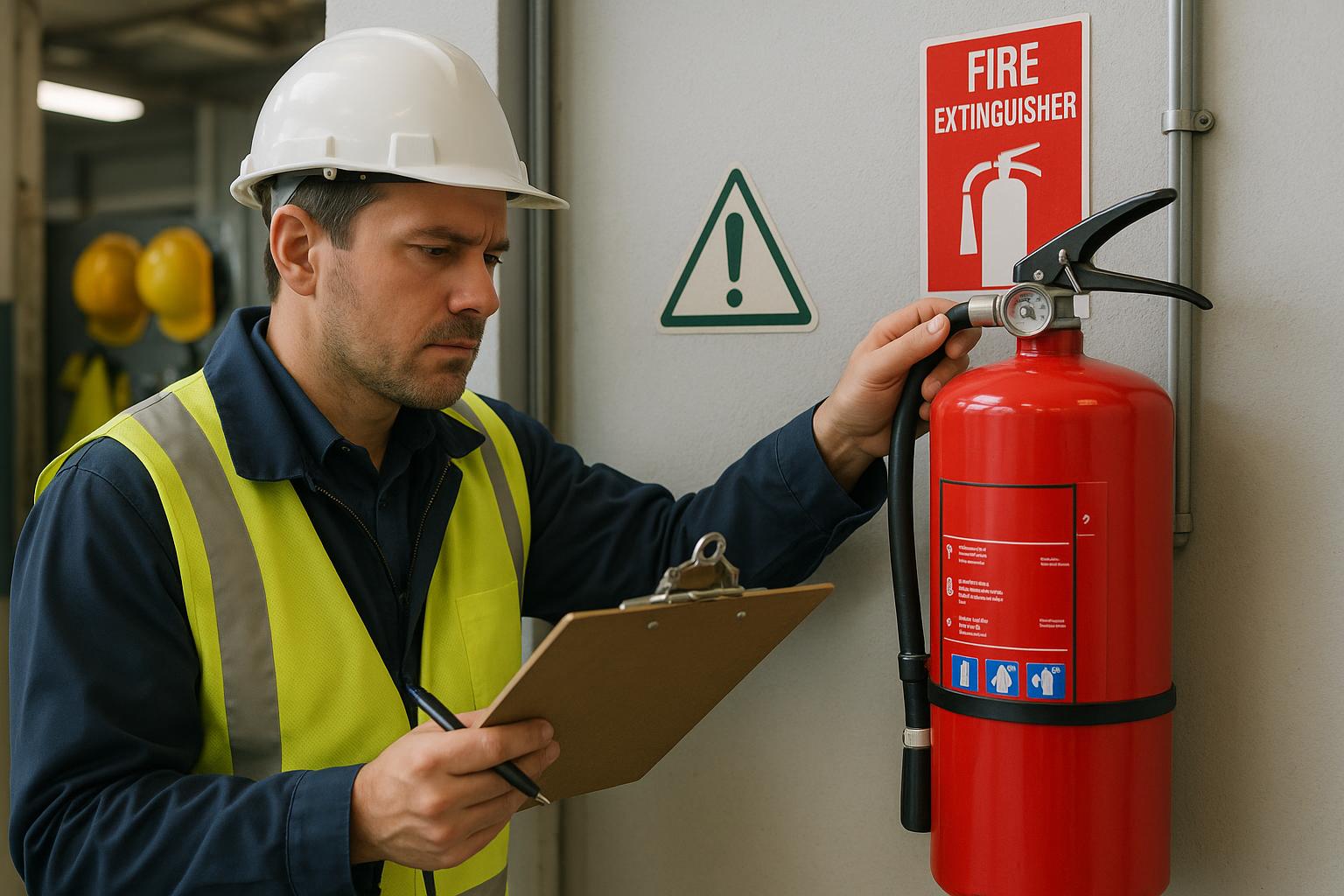
Fire extinguishers and annual fire drills are core elements of workplace safety and compliance. Each year, employers must verify that all extinguishers are in safe working order and that employees are ready to respond during an emergency. Annual fire extinguisher recertification and fire drill readiness checks help you meet legal requirements, protect people, and reduce the risk of business interruption.
Understanding Annual Fire Extinguisher Recertification
Fire extinguisher recertification is the formal process of inspecting, testing, and tagging fire extinguishers to confirm they are safe, operational, and compliant with applicable standards. In many workplaces, this is done by a licensed fire protection contractor and documented with an inspection tag or label.
In the United States, OSHA requires that portable fire extinguishers be visually inspected monthly and maintained annually according to NFPA 10, Standard for Portable Fire Extinguishers. Under 29 CFR 1910.157(e)(3), employers must ensure that annual maintenance includes a thorough examination of each extinguisher. NFPA 10 sets specific intervals for internal examinations and hydrostatic testing, depending on the type of extinguisher.
What to Verify Each Year on Every Extinguisher
- Correct type and location
- Verify that each extinguisher is the correct class for the hazards in the area, such as Class A for ordinary combustibles, Class B for flammable liquids, Class C for energized electrical equipment, and appropriate ABC or specialized units where needed.
- Confirm that extinguishers are mounted in the required locations, visible, and accessible without obstruction. The top of extinguishers weighing less than 40 lb should generally be no more than 5 ft (1.5 m) above the floor, with heavier units mounted lower, consistent with NFPA 10 guidance.
- Physical condition and damage
- Inspect the cylinder for dents, corrosion, leaks, or physical damage. Any extinguisher with structural damage should be removed from service.
- Check that the hose, nozzle, and handle are intact and free from cracks or blockages.
- Confirm that the safety pin is in place and secured with a tamper seal, and that there are no signs of unauthorized discharge.
- Pressure and gauge readings
- Confirm that the pressure gauge needle is in the operable (green) range. If the gauge shows undercharge or overcharge, the extinguisher must be serviced or replaced.
- For units without a gauge, follow manufacturer procedures for confirming readiness status and weight. Any loss of agent weight beyond allowable tolerance requires service.
- Labeling, signage, and instructions
- Verify that the operating instructions on the label are legible and face outward.
- Confirm that any required signage above or near the extinguisher is in place, clearly visible, and compliant with local code or company standards.
- Service, tagging, and documentation
- Ensure that a competent person performs annual maintenance and signs and dates the inspection tag.
- Check that prior service intervals such as six‑year maintenance for stored‑pressure dry chemical extinguishers and required hydrostatic tests have been completed on time, in line with NFPA 10.
- Maintain records of all inspections, maintenance, and tests for each extinguisher, including the serial number, type, and location.
Hydrostatic Testing and Replacement Timelines
Over time, fire extinguisher cylinders are subject to pressure cycles, corrosion, and wear. NFPA 10 requires periodic hydrostatic testing to confirm that cylinders can safely withstand pressure. For example, dry chemical stored‑pressure extinguishers typically require hydrostatic testing at 12‑year intervals, while certain carbon dioxide and water extinguishers may have different intervals depending on cylinder material and design.
You must verify annually that each extinguisher is within its required hydrostatic test interval. Extinguishers that are due for hydrostatic testing must be taken out of service and tested by qualified personnel or replaced. Any extinguisher that fails hydrostatic testing must be permanently removed from service.
Discharge Tests, Six‑Year Maintenance, and Seals
In addition to visual inspections, some extinguishers require more invasive maintenance at specified intervals. Many stored‑pressure dry chemical units require a complete internal examination and recharge every six years. During annual verification, check the tag or label to ensure that six‑year maintenance has been completed on time. If required maintenance is overdue, remove the extinguisher from service until completed.
Confirm that tamper seals are intact and that there is no evidence of partial discharge. If a unit has been used or partially discharged for any reason, it must be recharged by qualified personnel, even if the gauge appears in range.
Employee Training and Competency Checks
Extinguishers are only effective if people know how and when to use them. OSHA requires that employers provide education for employees who may be expected to use portable fire extinguishers. Each year, verify that employees:
- Know the location of the nearest appropriate extinguisher to their work area.
- Understand the classes of fire and which extinguishers are safe to use on each type.
- Can recall the basic PASS method (Pull, Aim, Squeeze, Sweep) for extinguisher operation.
- Know when to evacuate rather than attempt to fight a fire, consistent with your emergency action plan.
Document who has received extinguisher training, when it occurred, and the content that was covered. Refresher training should occur at least annually or more frequently if there are changes in equipment or procedures.
Annual Fire Drill Readiness: What to Verify
Alongside extinguisher recertification, annual fire drill readiness ensures that your emergency procedures work as intended under realistic conditions. The National Fire Protection Association strongly recommends regular fire drills, and many jurisdictions mandate drills at least annually in workplaces and facilities such as schools and healthcare occupancies. According to NFPA, in 2022 local fire departments in the United States responded to an estimated 1.5 million fires, resulting in 3,790 civilian fire deaths and about 13,250 civilian fire injuries, underscoring the need for effective preparedness.
During your yearly review, verify the following:
- Emergency procedures and roles
- Confirm that your written fire emergency plan is up to date, including evacuation routes, assembly points, and communication procedures.
- Verify that fire wardens or marshals are appointed for each area or shift and that their roles are clearly defined.
- Ensure that back‑ups are designated for critical roles in case key personnel are absent.
- Alarm systems and notifications
- Test fire alarms, notification systems, and any integrated voice communication systems to ensure they are functioning correctly.
- Confirm that employees can recognize alarm signals and understand what actions to take when an alarm sounds.
- Verify that procedures exist for alerting visitors, contractors, and people with hearing or vision impairments.
- Evacuation routes and assembly areas
- Walk all primary and secondary evacuation routes to confirm they are clearly signed, illuminated, and free of obstructions.
- Check that exit doors operate correctly, are not locked in a way that prevents egress, and open in the direction of travel, consistent with local code.
- Confirm that outdoor assembly points are clearly identified, far enough from the building and potential hazards, and suitable for all weather conditions.
- Headcount, accountability, and communication
- Verify that supervisors understand how to account for staff at assembly points and how to report missing persons to emergency responders.
- Confirm that communication methods during drills and actual emergencies are reliable, including radios, phones, or public address systems.
- Review how visitors and contractors are added to headcount lists and how their presence is tracked.
- Post‑drill review and corrective actions
- After each drill, perform a documented debrief to identify delays, bottlenecks, or confusion.
- Assign corrective actions with deadlines and responsible persons, and verify at your annual review that these actions have been completed.
- Use findings to update your emergency plan, training content, and communication strategies.
Integrating Extinguisher Recertification with Drill Readiness
The most effective programs integrate annual extinguisher recertification with fire drill readiness and broader emergency management. Each year, align extinguisher inspections, employee training, and drills so that:
- Employees see and practice using the same type of extinguishers installed in your facility, ideally through hands‑on training with training units.
- Changes in building layout, processes, or occupancy trigger reviews of extinguisher placement, evacuation routes, and assembly points.
- Records for extinguisher maintenance, fire drills, and training are centralized, easily retrievable, and used to demonstrate compliance during audits or inspections.
Well‑planned annual verification of fire extinguisher recertification and drill readiness supports compliance, protects people, and helps ensure that, if a fire occurs, your organization responds quickly and effectively.
References
- OSHA portable fire extinguishers – 29 CFR 1910.157
- NFPA 10 – Standard for Portable Fire Extinguishers (overview)
- NFPA fire loss in the United States (2022 report data)