Launching a new operation is one of the riskiest points in a company’s lifecycle from a safety and compliance standpoint. New equipment, new workflows and new people all come together under tight deadlines and cost pressure. That combination is exactly when OSHA and MIOSHA violations spike, and incident risk quietly climbs long before the first inspection happens.
Many leadership teams focus on permits and production capacity and assume “safety will follow.” Regulators and injury data tell a different story. The basics that get missed during start-up or expansion are often the same basics that lead to first citations, avoidable injuries and unplanned shutdowns.
This safety toolbox talk walks supervisors, safety professionals and operations leaders through the OSHA and MIOSHA readiness elements most often overlooked when standing up new operations, lines or facilities.
Why new operations are high-risk for OSHA/MIOSHA issues
When operations are new or changing, work-as-imagined and work-as-done rarely match. Written procedures may be incomplete, vendor manuals may be sitting in a binder, and workers are troubleshooting on the fly. That is where regulatory gaps appear.
OSHA’s enforcement data shows a consistent pattern: year after year, the same core standards show up in the Top 10 most frequently cited violations, including fall protection, hazard communication, respiratory protection and lockout/tagout (LOTO). These are foundational programs that should be fully in place before any new operation goes live.
MIOSHA, which adopts and supplements federal OSHA standards for Michigan workplaces, reports similar trends in its annual inspection summaries and consultation findings, with recurring issues around hazard communication, machine guarding, energy control, and training documentation in manufacturing and construction operations.
When these fundamentals are only partially implemented during start-up, employers may technically be “open for business,” but they are not OSHA/MIOSHA ready.
Overlooked compliance basic 1: Pre-start hazard identification and risk assessment
Many new operations launch before a formal, documented hazard assessment is finished. Teams do a quick walkthrough and assume they have “seen the hazards,” but OSHA and MIOSHA expect a systematic process.
For new operations, this should include at minimum:
- Task-based hazard assessment: Break each new job into steps and identify physical, chemical, ergonomic, noise and environmental hazards for each step.
- Equipment-specific assessment: Review each new machine or system for mechanical, electrical, thermal and pinch-point hazards, including non-routine tasks such as clearing jams, maintenance and cleaning.
- Change impact review: For expansions or line changes, evaluate how the new setup affects existing operations, traffic patterns, material handling and emergency egress.
The output is not just a checklist. It should drive written procedures, PPE selection, machine guarding needs, ventilation requirements and training content before employees perform the work.
Overlooked compliance basic 2: Incomplete written programs and procedures
OSHA and MIOSHA both require written programs for many core standards. During a new launch, companies often bring equipment online with “draft” procedures that are never finalized or aligned with specific regulatory requirements.
Common gaps include:
- Hazard Communication (HazCom): No location-specific written program, missing or incomplete Safety Data Sheet (SDS) inventory for new chemicals, and labeling not aligned with the Globally Harmonized System (GHS).
- Lockout/Tagout (energy control): Generic LOTO policy without equipment-specific energy control procedures, missing diagrams or isolation points for new machines and no verification step described.
- Respiratory protection: Respirators introduced for a new operation without a full written program, medical evaluations, fit testing and training.
- Powered industrial trucks: New forklifts or tuggers operating without a documented training program that covers site-specific hazards and equipment.
- Bloodborne pathogens or other special programs: New tasks such as first aid response or certain maintenance activities added without updating written exposure control plans.
Before start-up, validate that every new process has been checked against applicable OSHA and MIOSHA standards and that the required written programs and procedures are updated, controlled and accessible.
Overlooked compliance basic 3: Training that covers tasks but not standards
Many companies train employees on “how to run the line” but not on the regulatory requirements that govern that work. OSHA and MIOSHA expect both.
Typical training gaps at new operations include:
- Orientation that skips OSHA/MIOSHA rights and responsibilities, reporting expectations and anti-retaliation protections.
- On-the-job training (OJT) that shows workers how to work faster, but not how to recognize and report hazards, or how to use guards, LOTO devices and PPE correctly.
- No verification of competency for critical tasks such as powered industrial truck operation, confined space entry, LOTO application or hot work permitting.
- Contractors and temporary workers launched with only a brief site tour and no documentation that they received required safety training for the tasks and site hazards.
Training for new operations should be built from the hazard assessment and written programs. Each regulatory-required training element (such as HazCom, LOTO, PPE, powered industrial trucks, respiratory protection or bloodborne pathogens) needs defined learning objectives, records of attendance and a method to verify understanding.
Overlooked compliance basic 4: Machine guarding and safe access
New equipment is often installed under time pressure, and physical safeguards become “phase two.” That approach creates immediate OSHA/MIOSHA exposure.
Common issues seen during start-up include:
- Unguarded or poorly guarded points of operation, ingoing nip points, rotating parts and belts.
- Temporary bypassing or removal of interlocks, light curtains or presence-sensing devices during commissioning that is never reversed.
- Inadequate platforms, stairs, ladders and railing for routine access and maintenance.
- No documented process to evaluate and approve any guard or interlock changes after initial installation.
Before production ramp-up, confirm that a competent person has verified guarding and access according to applicable machine guarding and walking-working surface requirements, and that maintenance personnel are trained not to defeat safeguards.
Overlooked compliance basic 5: Emergency planning and first response
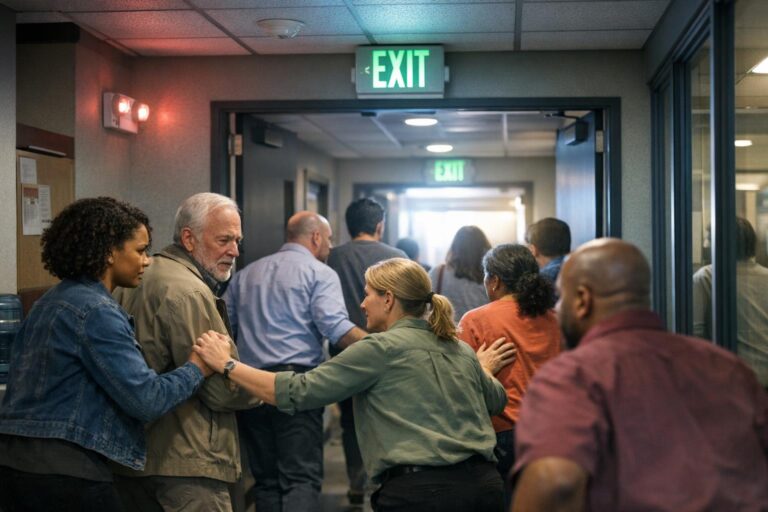
New operations can change how people evacuate, where they gather and how quickly first responders can reach affected workers. Updating the emergency action plan and related systems is often left until after start-up.
Key elements that should be reviewed and documented before going live include:
- Updated evacuation routes and maps that reflect new equipment layouts, storage areas and occupancy.
- Adequate and accessible exit routes, lighting and signage that meet OSHA/MIOSHA standards.
- Alarm systems that can be heard and seen across the expanded or new operation.
- Trained first aid and CPR responders on each shift, with appropriate supplies and eye wash stations where required based on chemical and task hazards.
- Coordination with local fire, EMS and law enforcement so they understand the new operation, hazards and access points.
Overlooked compliance basic 6: Documentation and recordkeeping readiness
Many organizations get the physical controls mostly right, but have weak documentation that creates problems during inspections and after incidents.
For a new operation, verify that:
- OSHA injury and illness recordkeeping obligations are understood, including which locations are required to keep OSHA 300, 300A and 301 forms.
- Safety data sheets, permits, inspection records, LOTO procedures, training records, equipment inspections and incident investigations are organized and retrievable.
- Any MIOSHA-specific posting and record requirements are met.
- Supervisors know what must be documented, how and where, before the first incident or near miss occurs.
A practical readiness checklist for new operations
Before you start up a new line, process or facility, a simple cross-functional readiness check can prevent recurring OSHA/MIOSHA issues. At minimum, verify that:
- A documented hazard assessment has been completed for all new tasks and equipment.
- Required written safety and health programs have been updated for the new operation.
- Task-specific and standard-specific training has been delivered and documented for employees, contractors and temporary staff.
- Machine guarding, access and fall protection needs have been inspected and approved.
- Emergency action plans, routes and first response capabilities have been revised and communicated.
- Recordkeeping systems and documentation practices are in place and understood by supervisors and safety staff.
Embedding this readiness check into your project or change management process makes OSHA/MIOSHA compliance part of “how we launch operations,” not an afterthought once production is already running.
Links referenced
- OSHA Top Ten Most Frequently Cited Standards (https://www.osha.gov/top10)
- MIOSHA Home and Standards Information (https://www.michigan.gov/leo/bureaus-agencies/miosha)