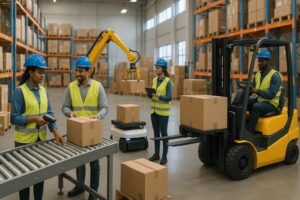
Material handling is often thought of as “just lifting and carrying,” but most workplace injuries happen in the moments before and after the lift. How materials are received, stored, moved, stacked, rolled, slid, pushed, pulled, and set down is just as important as how they are lifted. Safe material handling goes far beyond lifting technique and needs a full, system-wide approach.
A material handling safety toolbox talk should address how people, equipment, and processes interact. When even one of these pieces is ignored, the risk of strains, sprains, struck-by injuries, and property damage increases. This is especially true in warehouses, construction sites, manufacturing plants, and distribution centers where materials are constantly moving.
Understanding the Full Material Handling Cycle
Every task has a material handling “life cycle”:
- Receiving and unloading
- Inspecting and staging
- Moving and transporting
- Storing and stacking
- Order picking or issuing
- Final placement, installation, or disposal
Risk exists at each stage, not just during the lift itself. For example, a perfectly executed lift can still cause an injury if the load was stored too high, stacked incorrectly, or moved through a congested area. Thinking about the whole cycle helps workers identify hazards earlier and choose safer methods.
Common Hazards in Material Handling Beyond Lifting
Looking beyond lifting highlights several key hazard categories:
1. Path and Layout Hazards
- Narrow aisles or blind corners
- Poor housekeeping, such as debris, loose wrap, or banding on the floor
- Uneven surfaces, ramps, dock plates, and thresholds
- Inadequate lighting, especially in storage and exterior areas
These conditions increase the chance of trips, slips, falls, and collisions while workers are pushing carts, pulling pallet jacks, or operating forklifts.
2. Load Condition Hazards
- Unstable, top-heavy, or poorly wrapped pallets
- Hidden sharp edges, nails, or banding
- Wet, oily, or slippery packaging
- Overhanging or shifting loads on racks and shelves
Even when mechanical equipment does the lifting, an unstable load can collapse, fall, or shift suddenly, striking workers or causing muscle strains during manual repositioning.
3. Equipment and Tool Hazards
- Damaged or overloaded hand trucks, dollies, or pallet jacks
- Forklifts or powered industrial trucks with missing guards or warning devices
- Improperly rated slings, chains, or straps
- Using “makeshift” equipment that is not designed for the task
Poorly maintained or misused equipment can fail during movement or storage, leading to dropped loads, crushed fingers, or foot injuries.
4. Ergonomic and Repetitive Motion Hazards
- Repeated pushing, pulling, or twisting of carts and pallet jacks
- Frequent bending to reach low shelves or floor-level loads
- Reaching overhead for stored materials
- Awkward gripping of bulky or irregularly shaped items
According to the U.S. Bureau of Labor Statistics, overexertion and bodily reaction, which includes lifting, pushing, pulling, holding, and carrying, accounted for about 21 percent of all nonfatal workplace injuries and illnesses involving days away from work in 2020. This shows how often handling tasks, not only lifting, contribute to injuries.
Source: U.S. Bureau of Labor Statistics
Safer Planning Before Any Material is Moved
Safety in material handling beyond lifting begins with planning. Before workers touch a load or start a move, they should:
- Assess the load: weight, size, center of gravity, stability, and condition of packaging
- Plan the route: check for obstacles, traffic, floor conditions, lighting, clearances, and doorways
- Choose the right method: mechanical assistance, team lift, or engineering control such as chutes or conveyors
- Confirm destination: shelf height, rack capacity, and space for safe placement
Supervisors should support this planning by allowing time to inspect the route, reduce congestion, and adjust workflows so that safe methods are practical, not optional.
Using Mechanical Aids and Engineering Controls
Material handling beyond lifting depends heavily on mechanical aids and engineered solutions. These reduce the physical load on workers and minimize the need for high-risk manual handling.
Examples include:
- Pallet jacks, hand trucks, and trolleys for horizontal movement
- Forklifts and order pickers for vertical lifting and retrieval
- Conveyor systems to move materials over longer distances
- Gravity chutes for controlled descent of items
- Lift tables and height-adjustable workstations to keep work between knee and shoulder height
- Turntables and tilt fixtures to reduce twisting and reaching
Whenever possible, design tasks so that workers guide or control loads rather than support the full weight. Material handling procedures should clearly define when mechanical aids are mandatory based on load weight, size, and distance.
Ergonomic Practices for Pushing, Pulling, and Carrying
Even with equipment, workers often need to push, pull, or carry loads. Safe ergonomic practices help control strain and fatigue:
- Pushing is usually safer than pulling because it allows better control and uses body weight more effectively.
- Keep hands between mid-thigh and mid-chest height when pushing or pulling.
- Maintain a neutral spine and face the direction of travel rather than twisting.
- Use both hands on handles where possible and keep elbows close to the body.
- Reduce load size instead of making fewer, heavier trips.
- Avoid sudden starts and stops; use smooth, steady force.
Training should emphasize that pain, tingling, or fatigue are early warning signs of overexertion, not something to “work through.”
Safe Storage and Stacking Practices
Material handling risk continues when loads reach storage. Safe storage and stacking prevent falls, collapses, and the need for hazardous retrieval.
Key practices:
- Keep heavier items between knee and shoulder height whenever possible.
- Store frequently used items at waist height to reduce bending and reaching.
- Stack materials on flat, stable surfaces and avoid creating top-heavy piles.
- Do not exceed the rated capacity of racks, shelves, or mezzanines.
- Use proper dunnage, blocking, and wrapping to prevent loads from shifting.
- Keep aisles, exits, and emergency equipment clear.
Good storage design also reduces the need for workers to climb on shelves, stand on pallets, or reach dangerously to access materials.
Traffic Management and Communication
Wherever materials move, there is traffic. Forklifts, pallet jacks, carts, and pedestrians share limited space. Effective traffic management and communication are essential for preventing collisions and struck-by incidents.
Control measures include:
- Clearly marked pedestrian walkways and equipment lanes
- One-way systems where space is tight or visibility is limited
- Mirrors at blind intersections and adequate lighting in aisles and loading docks
- Audible and visual warning devices on powered equipment
- Standardized hand signals and radio communication for spotters and operators
Workers should be trained to make eye contact or otherwise confirm that equipment operators see them before crossing paths.
Personal Protective Equipment for Material Handling
PPE does not replace safe systems and engineering controls, but it adds a final layer of protection. For material handling beyond lifting, typical PPE includes:
- Safety shoes or boots with appropriate toe and metatarsal protection
- High-visibility garments in areas with vehicle traffic
- Cut-resistant or impact-resistant gloves based on material type
- Safety glasses or face shields when handling banding, strapping, or materials that may chip or shatter
- Hearing protection in high-noise material handling environments
PPE selection should be based on task-specific risk assessments rather than a one-size-fits-all approach.
Building a Culture of Safe Material Handling
Material handling beyond lifting is as much about culture as it is about procedures. Workers need to feel empowered to stop work when conditions are unsafe, report damaged equipment, and request assistance without negative consequences.
Regular toolbox talks should:
- Review recent near misses and lessons learned
- Reinforce inspection routines for routes, loads, and equipment
- Refresh ergonomic practices for pushing, pulling, and carrying
- Highlight examples where planning prevented an injury
When leaders recognize and reward safe behaviors during material handling tasks, the entire team becomes more likely to think beyond the lift and protect themselves and others.