Human Traffic vs. Equipment Traffic: Essential Safety Toolbox Talk for Every Worksite
Every worksite where people move around the same areas as mobile equipment carries a serious risk of strikes, crush injuries and fatalities. Managing how human traffic and equipment traffic interact is one of the most critical elements of workplace safety, whether you are in construction, warehousing, manufacturing, logistics or mining.
This toolbox talk explains the key risks, control measures and worker responsibilities to keep people and equipment safely separated and predictable.
Why human–equipment interaction is so dangerous
When people and equipment share the same space, the risk profile increases sharply. Forklifts, loaders, trucks, MEWPs, telehandlers and other mobile plant have large blind spots and often operate in noisy, busy environments where it is harder to see or hear pedestrians.
Common incident types include:
- Pedestrians struck by reversing vehicles or forklifts
- Workers pinned between equipment and fixed objects
- People walking into swing or articulation zones of plant
- People entering loading/unloading areas without being seen
According to the U.S. Occupational Safety and Health Administration (OSHA), approximately 70% of forklift accidents could be prevented with effective training and traffic separation measures (OSHA). The UK Health and Safety Executive (HSE) notes that being struck by a moving vehicle is one of the main causes of workplace fatalities (HSE).
Those figures underline how critical it is to design and enforce safe movement of both people and equipment.
Key principles of safe human and equipment traffic management
Effective control of mixed traffic environments relies on a few core principles:
- Separate wherever possible
The safest system is one that physically separates people from equipment. Use barriers, guardrails, designated walkways, and vehicle-only routes to prevent unplanned interaction. - Control where separation is not possible
When complete separation cannot be achieved, introduce strict controls: speed limits, one-way systems, traffic lights, spotters, and documented procedures for entering shared zones. - Make movements predictable
Clear rules about right of way, direction of travel, parking, loading and pedestrian crossings reduce surprises and allow both operators and pedestrians to anticipate each other’s actions. - Maximize visibility
High-visibility clothing, adequate lighting, flashing beacons, reversing alarms, cameras and mirrors all help equipment operators see and be seen. - Train and enforce
Systems only work if people understand them and follow them. Regular training, toolbox talks, supervision and enforcement are essential.
Designing safe routes for pedestrians and equipment
Every site should have a traffic management plan that maps and defines:
- Pedestrian walkways
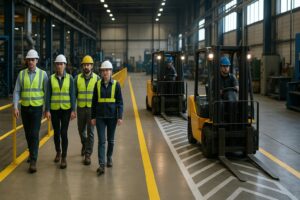
These should be clearly marked, continuous where possible, and protected by physical barriers in higher-risk areas such as near loading bays, entrances, blind corners and intersections. - Vehicle routes
Design routes with wide turns, minimized reversing, and separation from doors used by pedestrians. Consider one-way systems to reduce complexity and blind reversing. - Designated crossings
Provide dedicated crossing points where pedestrians must cross vehicle routes. Use signage, floor markings, speed control (e.g., speed bumps) and, in higher-risk environments, barriers or gates that require drivers to stop. - Restricted zones
Define exclusion zones where only authorized or trained persons may enter, such as loading docks, crane swing areas, and high-traffic forklift zones. Use signage, barriers, and access control.
Managing high-risk activities
Some tasks require closer interaction between people and equipment. These include loading and unloading, spotter-guided maneuvers, and maintenance.
Key controls include:
- Use a spotter only when necessary and trained
Spotters should be clearly visible, know the agreed hand signals, maintain eye contact with the operator where possible, and stand clear of pinch and crush zones. - Establish exclusion zones around operating equipment
Mark and enforce minimum distances. No one else should enter the zone without the operator’s acknowledgement and the equipment being brought to a safe state when required. - Minimize reversing
Plan work to reduce reverse driving. Where reversing is required, use cameras, mirrors, audible alarms, and a spotter where risk is high. - Lockout/tagout for maintenance
Before working on or under equipment, ensure it is isolated, secured against movement, and clearly tagged. Never assume an operator has seen you or knows you are there.
Responsibilities of equipment operators
Operators of forklifts, trucks and other mobile plant carry significant responsibility for the safety of others. Core expectations include:
- Conducting pre-use inspections and reporting defects, especially to brakes, steering, lights, and warning devices
- Obeying all site traffic rules, speed limits, one-way systems and signage
- Driving at a speed appropriate to conditions, including visibility, congestion and ground conditions
- Keeping to defined equipment routes and never using pedestrian-only walkways
- Ensuring loads do not obstruct visibility and are stable, secure and within rated capacity
- Never operating while distracted, under the influence of alcohol or drugs, or when fatigued
- Stopping work immediately if pedestrians are in unsafe proximity or traffic routes are obstructed
Operators should make eye contact with pedestrians when possible at crossings or in shared areas, but must never rely solely on pedestrians to stay safe. The assumption should always be that a pedestrian may step unexpectedly into the line of travel.
Responsibilities of pedestrians and other workers
Everyone on site has a role in preventing incidents involving vehicles and equipment. Core expectations for pedestrians include:
- Use designated walkways and crossings at all times, even if it takes longer
- Obey signage, barriers and restricted zones and never take shortcuts through vehicle routes
- Maintain awareness by avoiding distractions such as using mobile phones or wearing headphones in traffic areas
- Make yourself visible with required high-visibility clothing and avoid standing or walking in blind spots, especially directly behind or beside large vehicles
- Wait for eye contact and a clear signal from the operator before crossing in front of or behind moving equipment
- Never assume a driver has seen you, heard you, or will stop in time
Supervisors should lead by example, challenge unsafe behaviors, and support enforcement of traffic controls consistently.
Site-specific toolbox talk points
When delivering this toolbox talk on your site, apply the principles to your own layout and operations. Points to cover:
- Walk the main pedestrian and vehicle routes with the team and highlight:
- High-risk intersections or blind corners
- Shared zones where pedestrians and vehicles operate together
- Designated crossings and how they must be used
- Review equipment in use: forklifts, tugs, trucks, loaders, cranes, MEWPs and site vehicles. Discuss:
- Known blind spots and how they are controlled
- Required safety devices (lights, beacons, alarms, cameras)
- Site speed limits and how they are enforced
- Clarify who has authority to change routes or create temporary access points during projects or maintenance, and what approvals are needed.
- Reconfirm reporting procedures for near misses and unsafe conditions related to traffic. Near-miss reports are essential to improving physical controls and training before an incident occurs.
Checklist for daily practice
At the end of the talk, reinforce a simple daily checklist for everyone:
For operators:
- Are my vehicle checks complete and any faults reported?
- Are warning devices and lights working?
- Are routes clear and speed limits understood?
- Have I checked blind spots carefully before moving?
- Am I prepared to stop work if pedestrians enter my risk zone?
For pedestrians:
- Am I wearing required high-visibility clothing?
- Do I know today’s restricted zones and work areas for equipment?
- Am I committed to using walkways and crossings, no shortcuts?
- Will I avoid distractions and stay alert around vehicles?
- Will I report unsafe traffic behaviors or conditions?
When human and equipment traffic are managed with clear design, consistent rules and shared responsibility, the worksite becomes significantly safer and more efficient. Every worker, whether on foot or behind the controls, contributes directly to preventing serious harm through disciplined adherence to traffic management systems.